
Authorization evidence, built inside your boundary.
Ratify reads your policies and system evidence and returns cited, reviewer-ready findings against NIST SP 800-171 and the NIST SP 800-53 catalog. It runs on a single workstation with a local open-weight model and no external network egress.
About 90 seconds, narrated. The assessment shown runs on the RealCo policy set (a real organization’s policies, renamed, used with permission). Walk through a recorded run step by step
From policy corpus to a package ready for your signature.
Every control, cited to its source.
Point Ratify at your policy and procedure corpus and choose the control set. It settles each control on one local GPU, and every finding carries the document and section it came from. A finding whose citation cannot be verified keeps its status and is flagged ungrounded, so the reviewer sees it. Ratify will not defend a claim it cannot cite.
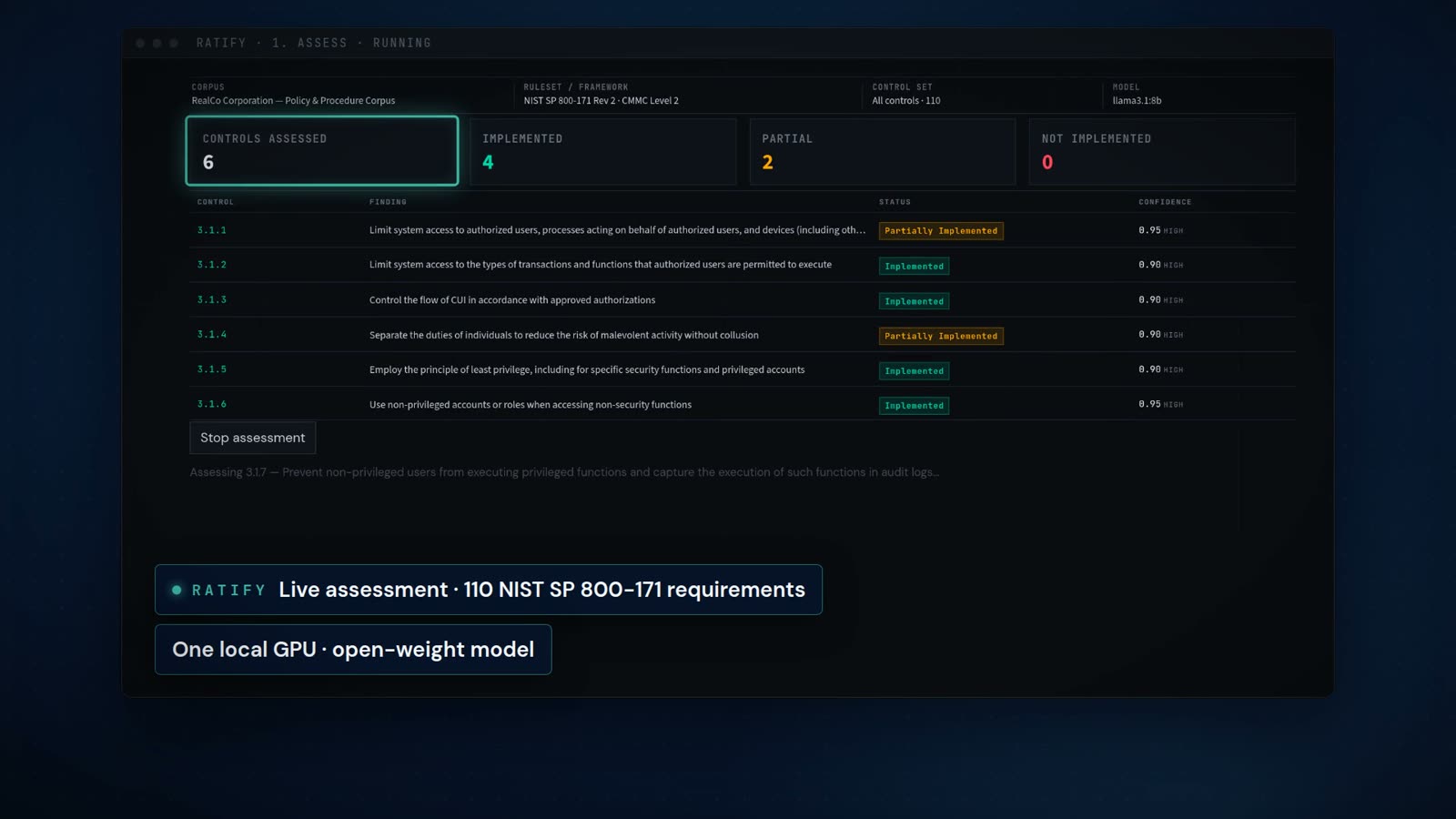
At the resolution your assessor scores.
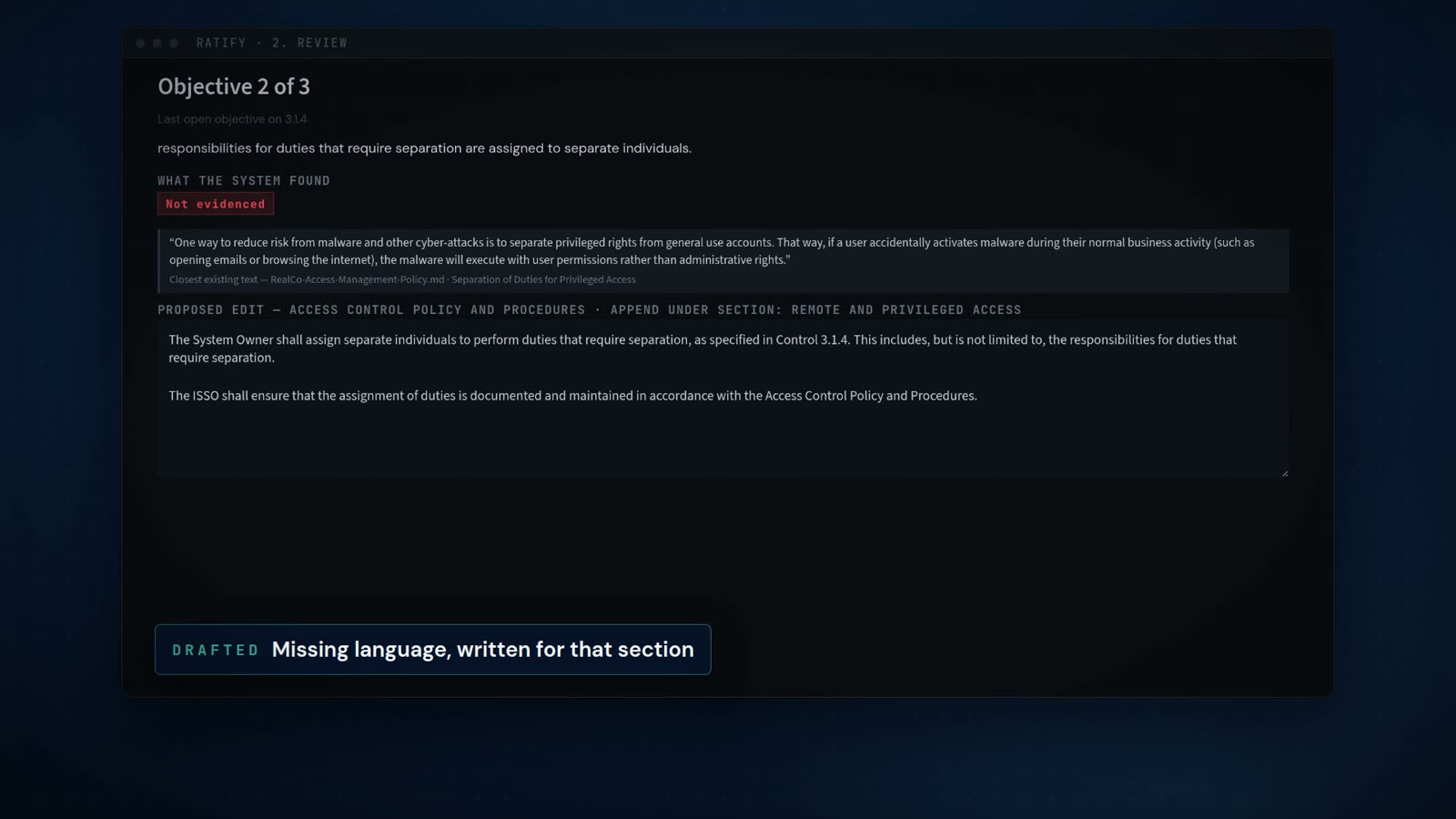
Ratify works at the objective level, not just the control. On the mature corpus that scores 100 percent at the control level, about one objective in four is not fully evidenced (24.2 percent, five repeats; 12.9 percent receive no credit at all). Better to find that before handoff than after the AO sends it back.
Where the language is missing, Ratify drafts it for that section of that policy.
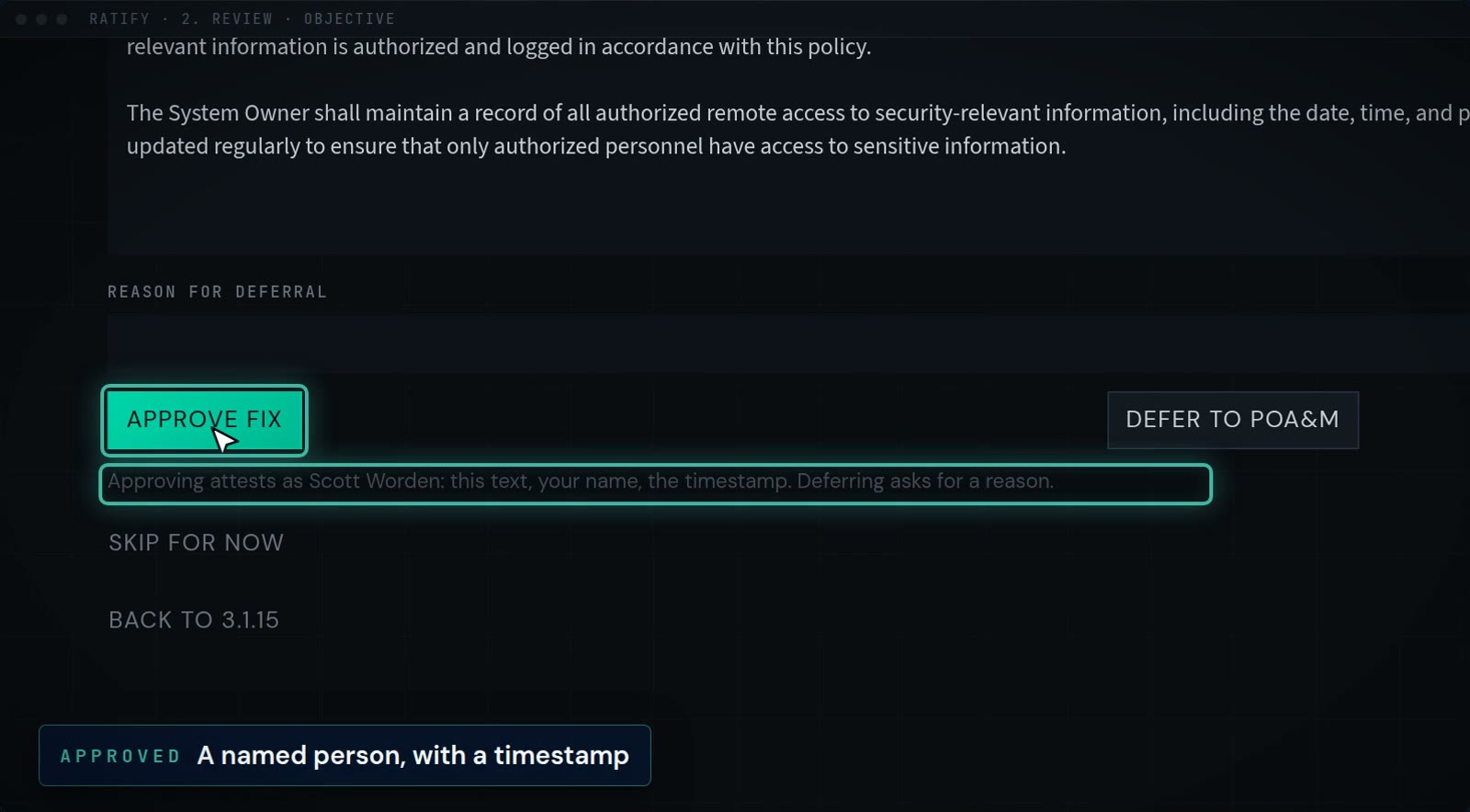
A named person approves every change.
Approving attests with your name and a timestamp. Deferring asks for a reason and records it in the audit record, and the control stays on the POA&M register. The operator, not the software, makes the decision.
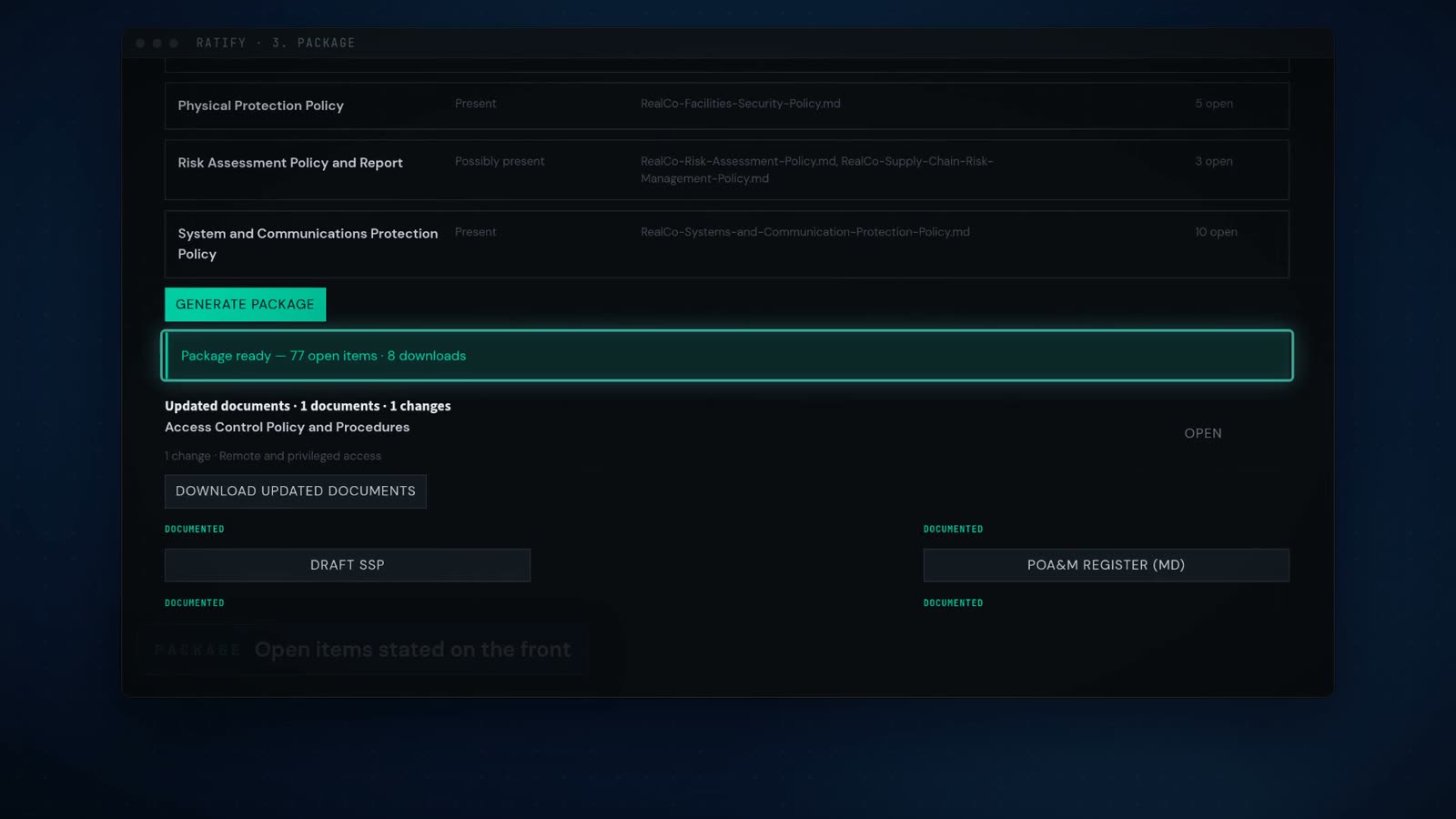
The package builds as you go.
Each approval lands in the policy as a tracked edit. Ratify assembles the draft System Security Plan, the POA&M register, and the updated documents, with open items stated on the front. Final review and signature stay yours.
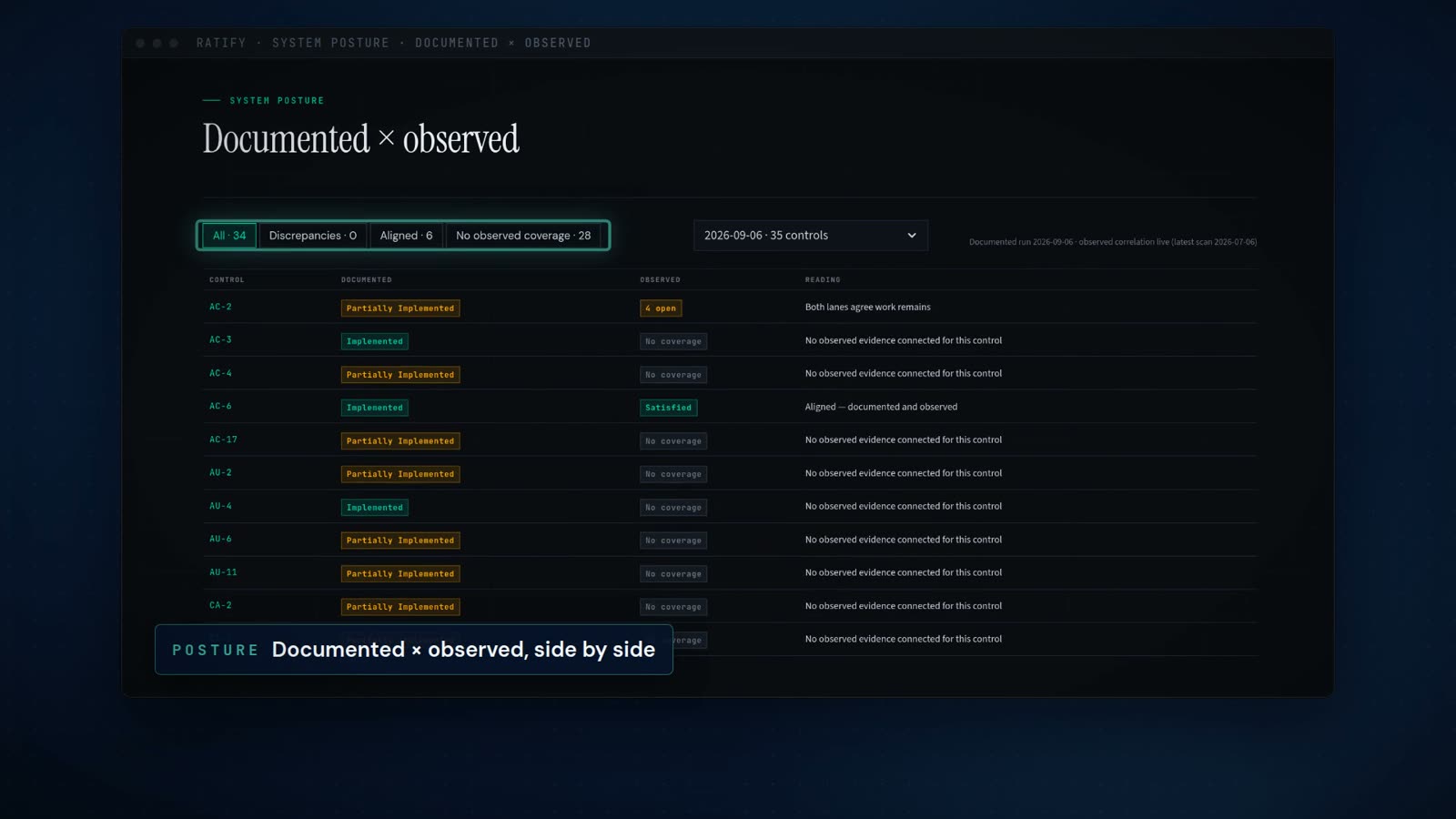
The paperwork, next to what your scanners found.
Ratify ingests .nessus exports and SCAP results and maps findings that carry a CCI to the governing NIST SP 800-53 control by fixed, revision-aware rules, with no model in that lane; CVE findings map through a separate cited lane. The result sits side by side with what the documents say.
Re-run both after each change or scan, and the gap between paperwork and systems stays visible.
Numbers with their scope attached.
Figures come from Adaptt's bounded internal benchmarks and adjudicated evaluation sets, measured on the hardware described below, with trace artifacts and reproduction paths retained for every number. Bounded local evidence; not adjudicated certification accuracy, assessor acceptance, or proof of operational implementation.
One node, inside the boundary.
| Status | Operating. Technology readiness level 5, self-assessed against the Department of Defense TRL definitions. |
|---|---|
| Hosting | On premises, inside the customer boundary. Reference node: a single NVIDIA RTX PRO 5000 Blackwell, about 48 GB of video memory. At capped serving context the default model used about 8 to 10 GB of video memory in our measurements; smaller cards are untested. Container-portable; network-none operation verified. |
| Models | Local open-weight models, engine-neutral. The model is a replaceable, measured component; no cloud dependency. |
| Data path | Zero egress. The evidence corpus, retrieval index, generation, and outputs stay inside the enclave. A socket-level guard aborts any run that attempts a non-allowlisted connection, and every run records its zero-egress verification. |
| Frameworks | NIST SP 800-171 and the NIST SP 800-53 catalog, on the same pipeline. |
| Inputs | Policy and evidence documents (txt, md, pdf, docx); XCCDF and ARF results; .nessus exports; existing RMF artifacts. |
| Outputs | Draft System Security Plan; POA&M register in CSV, Markdown, and JSON; evidence review packets; remediation handoff; and an authorization archive with manifest and audit record, structured for interchange with eMASS. |
See it run on your policies, inside your boundary.
We'll walk you through Ratify running live, then talk through running it on your own policy set inside your boundary, where nothing leaves the machine.